Who’s Behind All the Glossy Mailers Attacking Eunisses Hernandez and Promoting Traci Park? An expose of the so-called "Neighbors First" dark money network
There’s a group that has been showing up in Los Angeles communities — knocking on doors, hosting local meetings, filling mailboxes with slick political mail. They say they’re fed up. They say the city doesn’t work for regular people anymore. They call themselves “Neighbors First.”
They are not your neighbors.
They’re part of a political machine built and controlled by a Republican law firm north of San Francisco. Their money comes from donors whose names we are not allowed to know. And their agenda — defeating progressive candidates, reshaping LA City Council, and serving a specific set of wealthy outside interests — is being carried out in your neighborhood right now, without your knowledge.
This is not their first city.
What Is Happening on the Ground
If you live in certain parts of Los Angeles, you may have already seen it. What lands in your mailbox — and what it says — depends on where you live.
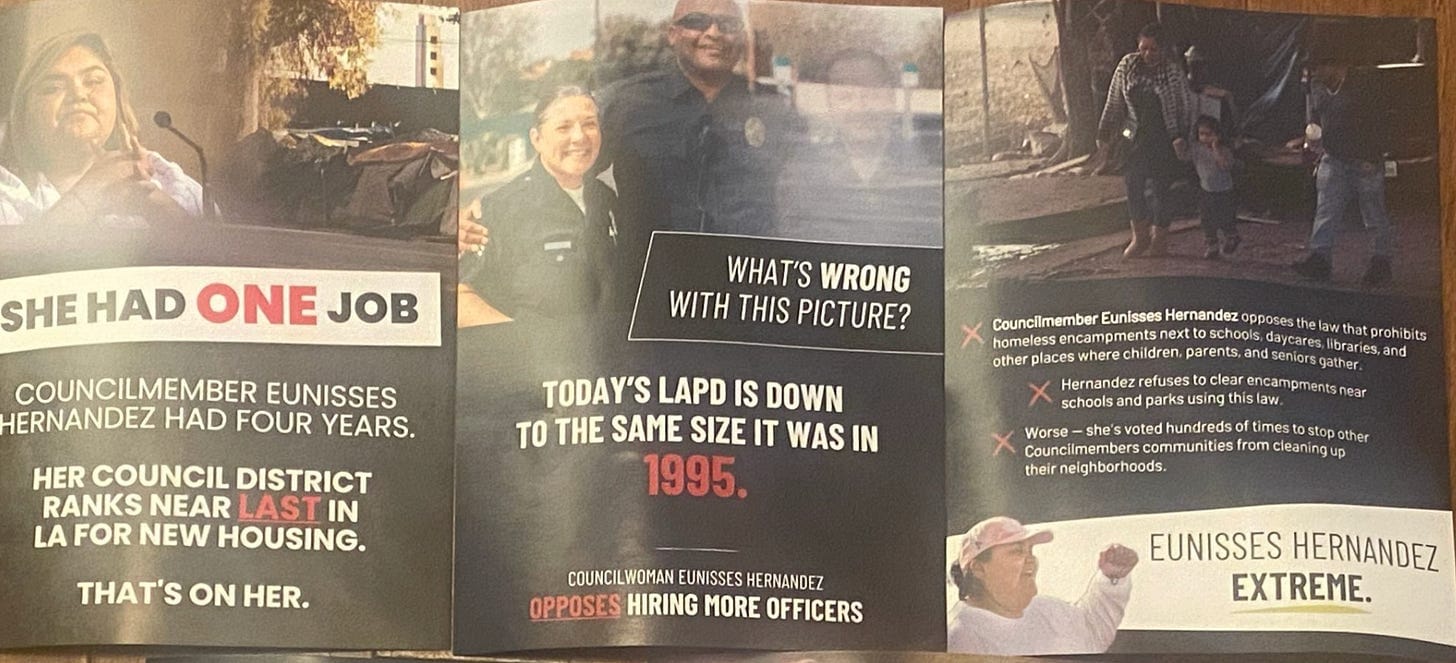
On the Eastside — in Echo Park, Highland Park, Lincoln Heights, Koreatown, and Pico-Union — residents in Councilmember Eunisses Hernandez’s Council District 1 have been receiving dark, aggressive attack mailers. Shadowy images of encampments. Bold red type. The word “EXTREME” in all caps under Hernandez’s name. One mailer accuses her of protecting encampments near schools. Another hits on police staffing: “LAPD has the fewest police officers in over 40 years. AND SHE VOTED AGAINST HIRING.” The messaging is calibrated to trigger maximum anxiety among persuadable voters.
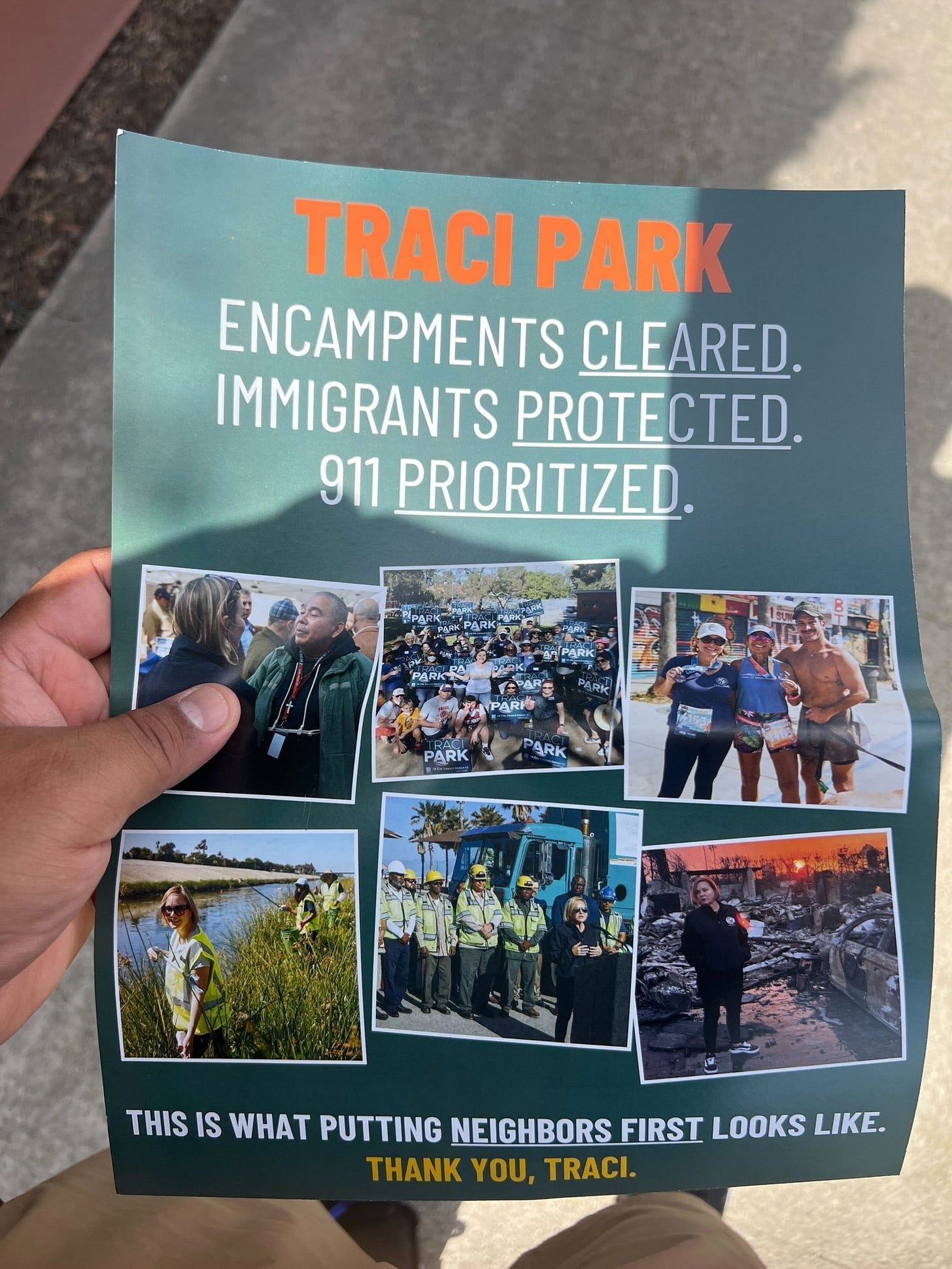
On the Westside — in Venice, Mar Vista, Del Rey, and the communities still recovering from the Palisades Fire — Council District 11 residents have been getting something different from the same group and same P.O. Box. Here the tone is warm, the photos are smiling, the headlines read like thank-you notes. “TRACI PARK HEARD US. AND, SHE GOT TO WORK!” Four separate pieces credit Park on encampments, the fire recovery, and — notably — protecting immigrants from ICE. That last claim attempts to inoculate her from one of challenger Faizah Malik’s most potent criticisms of Park’s record: she opposed the city’s sanctuary city ordinance, warning that it harbors “violent criminals,” and has supported the installation of surveillance cameras across the district. A Neighbors First mailer presenting a side-by-side comparison of Park and Malik claims Malik is the one benefitting from money outside the district.
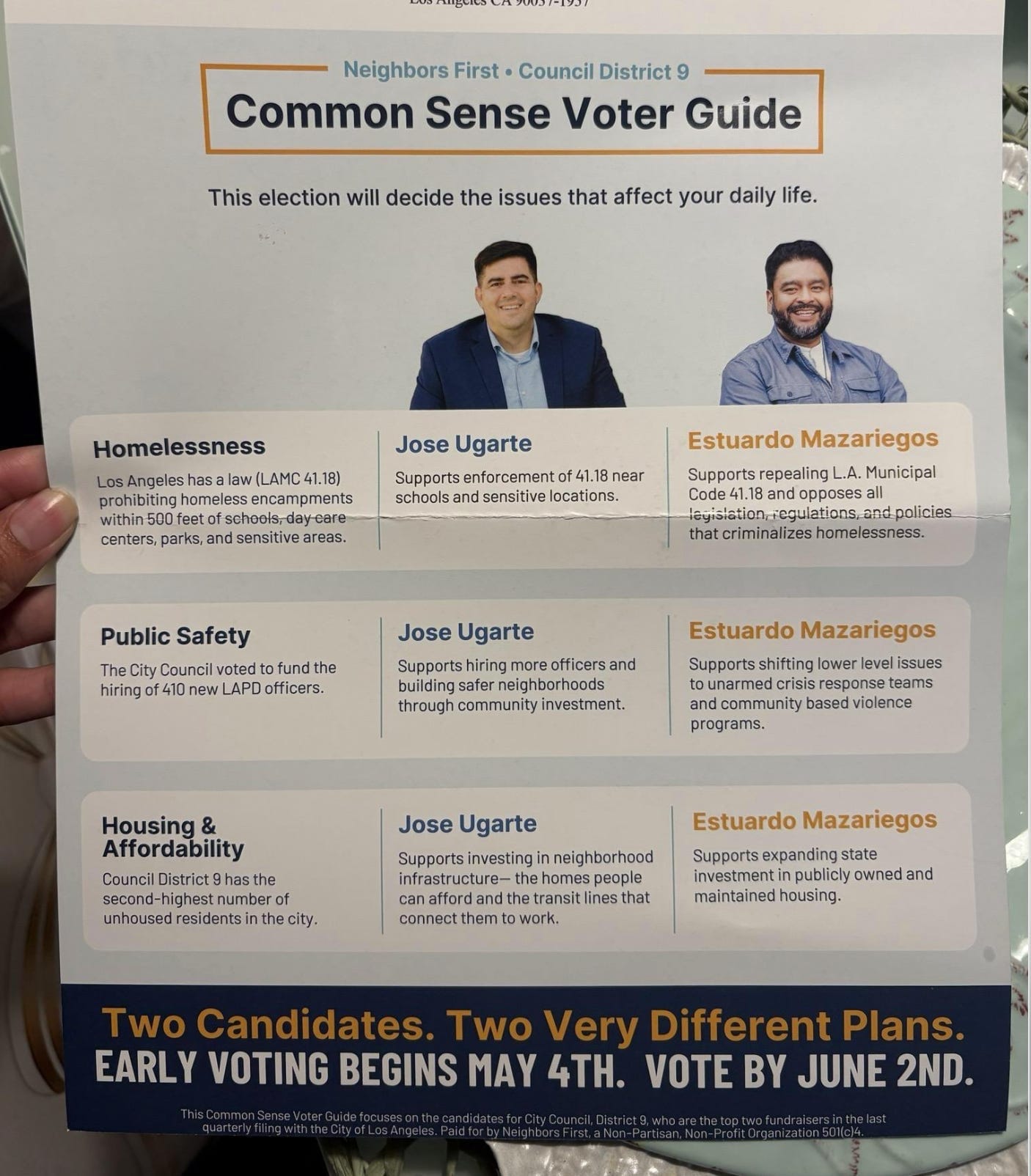
In South Los Angeles — in the Council District 9 open-seat race to succeed Councilmember Curren Price — the operation is running the same attack playbook against Estuardo Mazariegos, the candidate most closely aligned with the council’s progressive bloc. Homelessness, public safety, encampments. South LA communities have experienced chronic underinvestment and real public safety challenges for decades. The operation didn’t invent those concerns. It just found them useful. A mailer titled “Common Sense Voter Guide” contrasts the positions of Mazariegos and Jose Ugarte, a City Hall staffer, saying “Two candidates. Two very different paths.”
None of these mailers say “vote for” or “vote against” anyone. They are careful never to use the precise legal language that would define them as campaign expenditures and trigger disclosure requirements. But no one receiving a mailer with a “This What Failing Looks Like” headline over a photo of Hernandez’s head has any doubt about what they’re being asked to do. No one who gets a mailer called a “voter guide” is confused about the intent. They are campaign ads. They are just legally engineered to avoid being treated as such.
To understand why this operation is targeting these three races, it helps to understand what the candidates actually represent. Hernandez is one of the council’s sharpest critics of LAPD spending, one of its strongest pro-immigrant voices, and a consistent champion of renters and low-wage workers. Park is one of the council’s most reliable votes for the police union and corporate landlords, has opposed sanctuary city protections for immigrants, and voted against wage increases for low-wage hotel workers. Mazariegos in Council District 9 is the candidate in that race most closely aligned with the council’s progressive bloc. The same dark money operation is attacking all three progressives and defending the one conservative. That is not a coincidence. It is the point.
Offense on the Eastside and in South LA. Defense on the Westside. Three races, one operation, zero disclosure.
Who Is Doing This — And What Do They Want?
Here is the honest answer: we don’t entirely know. And that is precisely the way this operation was designed to work.
Whoever is funding Neighbors First has gone to considerable lengths to remain invisible. The group has no public donor list. It has no required financial disclosures at the state level — the California Attorney General formally exempted it from reporting requirements. It has structured its political communications to avoid the legal definitions that would trigger campaign finance disclosure. The people writing the checks could be a handful of wealthy individuals. They could be corporations. They could be out-of-state or even interests with no connection to Los Angeles whatsoever. We don’t know, because we’re not allowed to know.
What we do know is who built the machine they’re writing checks into.
Nielsen Merksamer is not a neutral law firm doing nonpartisan civic work. Over four decades, it has served as legal counsel for more than 435 ballot measure campaigns — almost always on the conservative side. They represented the gig economy platforms behind Proposition 22, the 2020 ballot initiative that stripped app-based workers of employee protections and was, at the time, the most expensive ballot measure in California history. Theirclient list includes theHoward Jarvis Taxpayers Association, the California Apartment Association, the San Francisco Apartment Association, the Western States Petroleum Association, and the California Business Roundtable. They have represented Airbnb and Lyft. They are legal counsel to New Majority California and Californians Against Higher Taxes. They have a long history of building legally sophisticated political structures that serve conservative and corporate interests while keeping donor identities out of public view.
Lucas personally created and controls at least seven distinct political organizations across California — in Los Angeles, San Francisco, and Oakland —all registered to the same address: his firm’s office north of San Francisco. He is not a lawyer who occasionally helps political clients. He is the architect and operational controller of a statewide conservative political infrastructure.
The Network of Organizations
Lucas has built three interconnected entities currently active in Los Angeles, each serving a distinct function:
Vibrant Los Angeles is the 501(c)(3) arm — the “public education” vehicle. Donations to it are tax-deductible. It can’t spend directly on elections, but it provides the intellectual and organizational foundation for the operation, and it transfers resources to its sister organizations.
Vibrant Los Angeles Action is the 501(c)(4) political arm. It can spend unlimited money on issue advocacy without disclosing a single donor.
Neighbors First is the 501(c)(4) attack and field operation — he one putting mailers in your mailbox and door hangers on your door. It was formed on September 23, 2025. On October7, Neighbors First filed with the California Secretary of State, the firm simultaneously requested a California Attorney General exemption from state reporting. That exemption was formally granted on February 12, 2026
The three-entity structure is not accidental. It maximizes legal flexibility, multiplies spending capacity, and creates overlapping layers of donor anonymity. And feeding into all three is a fourth organization: Govern for California Foundation, a statewide network of 18 separately registered PAC chapters that Lucas also controls — each able to contribute up to $8,100 to a candidate per election, for a combined total of up to $145,800 per candidate from what is effectively a single coordinated donor network. GFC has contributed $12 million to more than 150 California candidates over 11 years. Sixty-two percent of that money came from just 20 donors. We know some of their names from public FPPC filings: Marc Merrill, co-founder of Riot Games; Larry Allbaugh, CEO of one of Sacramento’s largest commercial real estate firms; Kilroy Realty, which has funded anti-progressive campaigns in Los Angeles; and a cluster of finance investors and tech executives. These are people with direct financial stakes in how city councils vote on housing, wages, and development — and they have been funding this network’s expansion from San Francisco to Los Angeles. The FPPC opened a formal investigation into GFC in October 2022. GFC was cleared of specific charges in January 2026 — though investigators noted ongoing concerns about coordination between the chapters.
What They Did in San Francisco
This is a tested playbook. And one of these organizations actually says so in its own published materials.
From roughly 2020 to 2024, this same network — same law firm, same legal structure, same donor profile — systematically reshaped San Francisco politics. They funded the recall of progressive District Attorney Chesa Boudin, the first successful DA recall in SF history. They flipped the Board of Supervisors from progressive to moderate, elected a moderate mayor, and passed a ballot measure restructuring city commissions to reduce progressive oversight power. The result was a durable political realignment — a new governing majority that has moved to reverse progressive housing, labor, and public safety policies.
That is not a characterization. Those are their words, in their own documents, on their own website.
The San Francisco operation took roughly four years to achieve a lasting political transformation. The Los Angeles operation launched in 2024 and 2025. If the timeline holds, 2026 is not the end state. It is the opening move.
How They Got Started in Los Angeles
The current operation didn’t emerge out of nowhere. It is the latest — and most sophisticated — iteration of a years-long campaign by LA’s corporate and real estate establishment to roll back the progressive gains of the last three city election cycles.
In 2022, Eunisses Hernandez unseated incumbent Gil Cedillo in Council District 1, and Hugo Soto-Martinez defeated incumbent Mitch O’Farrell in Council District 13. Both ran as unapologetic progressives — on tenant protections, police accountability, and community-centered approaches to homelessness — and both won. Together with Nithya Raman in Council District 4, they formed the council’s progressive bloc and immediately set about trying to shift the council’s priorities.
The backlash was swift. In 2024, a coalition of corporate landlords, real estate developers, and the police union poured nearly $1.4 million into unseating Raman. Douglas Emmett Management, one of LA’s largest corporate landlords, contributed $400,000 to the Los Angeles Police Protective League’s PAC, which ran attack ads against her. Kilroy Realty chipped in $100,000. A separate PAC called Thrive LA added its own six-figure spending to the pile. Raman prevailed, bolstered by PACs led by LA Forward and the hotel workers union. But the effort announced something important: the corporate and real estate interests that stood to lose the most from a strong progressive bloc on the council were willing to spend serious money to defeat progressives — and they were going to keep escalating until they succeeded.
The formation of Vibrant LA and Neighbors First is that escalation. Brad Conroy, who served as CFO of Thrive LA, is now the CEO of Vibrant LA Action. The same people who built the earlier operation are now running the darker, legally invisible one. Where Thrive LA is a registered PAC required to disclose its donors, Vibrant LA Action and Neighbors First are 501(c)(4)s — structured from the ground up to keep their finances out of public view. In July 2025, Vibrant Los Angeles received its IRS tax-exempt determination. On that same day, GFC’s president published a post on GFC’s website announcing that “our friends at Vibrant LA” had asked GFC to support four LA City Council candidates: Traci Park (Council District 11), Tim Gaspar (Council District 12), Jose Ugarte (Council District 9), and Lou Calanche (Council District 1). GFC’s chapters began making contributions within days.
Then came the ground operation: door hangers across LA neighborhoods in November 2025, “constituent meetings” with free dinner in December 2025 and February 2026, including one at a Denny’s on York Boulevard in Highland Park, deep inside Councilmember Hernandez’s district. Voter contact and list-building, dressed up as neighborhood listening sessions.
And then there is the matter of who agreed to serve as the local face of the operation. The CEO of Neighbors First — confirmed in a sworn California Secretary of State filing — is a man named Wilson Gee, described by sources as a Chinatown neighborhood council board member from one of the original families of Chinatown, and a prominent supporter of the proposed gondola connecting Dodger Stadium to Union Station. The gondola’s most vocal opponent on the City Council is Eunisses Hernandez — the councilmember whose district the gondola would run through, and the same councilmember whose face appears on the “EXTREME” attack mailers funded by the organization whose CEO is a gondola advocate. Whether that connection is coincidence or strategy, it illustrates exactly how this model works: outside money provides the infrastructure, and local actors with their own agendas provide the human face.
How Is This Legal?
The most common question people ask when they first hear about this is: how is any of this legal?
The honest answer is: mostly, yes — and entirely by design. The operation avoids disclosure at three distinct levels: who funds it, how much it spends, and the full scope of what it’s doing.
Who funds it. Under federal law, 501(c)(4) social welfare organizations are not required to disclose their donors. The IRS keeps donor lists confidential. California law requires many politically active nonprofits to register with the state and report major donors — but as noted above, the California Attorney General formally exempted Neighbors First from those requirements on the same day it filed for state registration. LA city campaign finance law requires disclosure only from organizations making “independent expenditures” — a category triggered only by express advocacy (see below). The result: no public donor disclosure is required at the federal, state, or local level.
How much it spends. Under both California law and LA city ordinance, campaign finance disclosure is only triggered by communications containing “express advocacy” — specific words like “vote for,” “vote against,” “elect,” or “defeat” a named candidate. Neighbors First’s mailers carefully avoid those words. “EUNISSES HERNANDEZ: EXTREME” is not “vote against Eunisses Hernandez.” “TRACI PARK HEARD US” is not “vote for Traci Park.” By staying just inside these legal lines, the operation classifies its communications as protected “issue advocacy” — constitutionally protected speech about public affairs, not campaign expenditures subject to disclosure. The result is a structural absurdity. A Form 57 filed with the LA Ethics Commission shows that Outfront Media, a national billboard company, spent $33,920 on pro-Park billboard advertising — and was required to publicly disclose it because it is a corporation making what the city defines as an independent expenditure. Neighbors First, which ran a months-long, multi-district political operation vastly larger in scope, has disclosed almost nothing. The more sophisticated and deliberate the political operation, the less it has to reveal.
The full scope of what it’s doing. The three-entity LA structure — Vibrant Los Angeles 501(c)(3), Vibrant Los Angeles Action 501(c)(4), Neighbors First 501(c)(4) — distributes activities across organizations with different disclosure obligations, different legal purposes, and different regulatory authorities. There is no single filing or database from which the full scope of the combined operation can be reconstructed. The 501(c)(3) arm files a Form 990 annually — but with a reporting lag of up to 18 months, meaning its real-time activity is never publicly visible while it is happening. The 501(c)(4) arms have no donor disclosure requirements and no required reporting of issue advocacy spending. And GFC’s 18 separately registered PAC chapters each file their own disclosures, fragmenting what functions as a single coordinated donor network across 18 separate public records. Nielsen Merksamer serves as registered agent, officer, and legal counsel for all entities — but that coordination relationship does not appear in any public disclosure.
Neighbors First has zero public financial reporting obligations at the federal, state, or local level. That is not a gap in the law. It is the intended outcome of a deliberate legal architecture, designed by one of California’s most experienced political law firms, and formally blessed by both the IRS and the California Attorney General.
What’s at Stake
The goal of this operation is not merely to win a few council seats. It is to reorder Los Angeles politics — to shift who holds structural power in this city, and for how long.
For decades, the central organizing question of LA city government has been: whose interests does the city primarily serve? That matters because of what city councils actually do. Housing policy. Development contracts. Police budgets. Worker wages. Land use. Who benefits when the city spends money, and who doesn’t. These decisions shape daily life in Los Angeles in ways most people don’t follow closely — which is precisely why a well-funded outside operation can move them without much resistance.
And here is the dimension that gets too little attention: this structure doesn’t have to stop when the election does. A councilmember who wins in November and takes office in December could face a fully-funded operation running against them from their very first day in office — not as a campaign, just as a permanent condition of governing. That councilmember cannot legally raise campaign money to respond, because they are not in an active race. There is a million-dollar operation on one side and a public official with no legal mechanism to fund a response on the other. That is not a political fight on equal terms. That is a one-sided war.
We know the playbook. We know the firm. We know the address.
What we don’t know is who’s writing the checks. And by design, we may never find out.
Former Los Angeles City Councilmember Mike Bonin is a teacher, writer, activist, podcaster and local leader with nearly 30 years experience in government, politics, and public service.